
WORLDWIDE
AND GROWING
610 SCHOOLS
BILINGUAL
EDUCATION
QUALITY
IN CANADIAN
EDUCATION
EXCELLENCE
 Canadian Education
Why choose Canadian education?
Canada’s education system consistently ranks among the best in the world.
Every three years, PISA (Programme for International Student Assessment) has been conducting surveys to measure 15-year-old’s ability to use their reading, mathematics and science knowledge and skills to meet real-life challenges. It also has developed ways to assess more contemporary topics like financial literacy and collaborative problem-solving.
Since PISA’s inception in 2000, Canada consistently ranks in the top 10 in all three domains out of all participating OECD countries. In fact, Canada ranks ahead of the systems in the US and the UK because the OECD measures an entire country’s system, not just hot spots of excellence which are not accessible to all due to geography or cost. In the vast Canadian public system, every child has access to quality schools. Canada excels not only in studies in the English language, but is also a world leader in bilingual education.
The strength of the Canadian education system, as evidenced by Canada’s PISA ranking, can provide Maple Bear parents with the trust that the Maple Bear curriculum retains a high standard of quality.

 Bilingual Education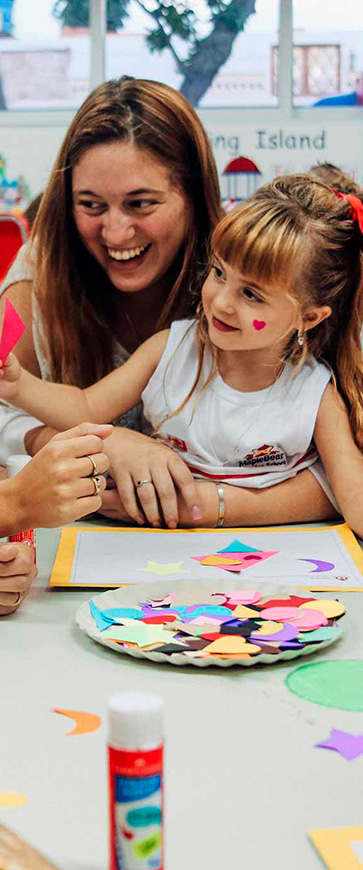
Benefits of a bilingual education
Bilingual education is the use of two different languages in the classroom instruction of academic content. At Maple Bear, students study all academic subjects in either their native language or a second language, depending on the subject and grade level.
Students don’t just memorise vocabulary in a Maple Bear classroom. This is a key difference between the programs offered at Maple Bear and the ESL training offered at other centres claiming to offer a bilingual education.
Furthermore, at Maple Bear, students begin learning a second language in pre-school using a immersion learning system based on Canadian educational pedagogy and best practises.
There have been concerns that teaching children two languages at once only confuses them. Fortunately, there has been much research—much of it conducted by Canadians—which shows that far from handicapping children, bilingual education can offer benefits from infancy to old age.
So what are the benefits of bilingual education for young learners?
For a start, it’s very good for language development, a goal of many of our parents who chose Maple Bear for their children. Young learners have also been shown to have:
- better concentration, analytical skills and multi-tasking capabilities;
- they learn to read sooner than monolingual students;
- they have an increased sense of self-worth and identity;
- they have the ability to live abroad and learn other foreign languages later in life;
- enjoy exposure to more than one culture which leads to a global perspective.
Numerous studies have confirmed that being bilingual actually makes a person smarter as it has a profound effect on the brain, improving cognitive skills and sharpening memory.
 Maple Bear Difference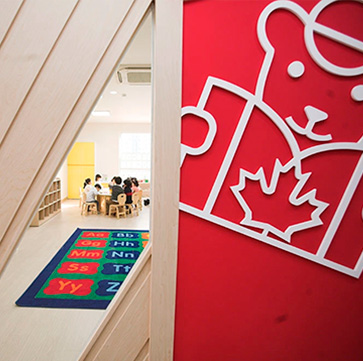
How is Maple Bear different from a traditional childcare centre?
Maple Bear offers a unique educational experience that sets us apart. Our bilingual program fosters cognitive development and global awareness from a young age. Inspired by Canadian educational best practices, our curriculum emphasizes academic excellence, creativity, and critical thinking.
We believe in the power of community and collaboration, encouraging active involvement from parents and the broader community. Our dedicated team of educators undergoes rigorous training to provide an enriching and engaging learning environment for children.
While traditional childcare centres provide essential care, Maple Bear goes beyond to inspire a lifelong love for learning and prepare children for future academic and personal success.
 Maple Bear Schools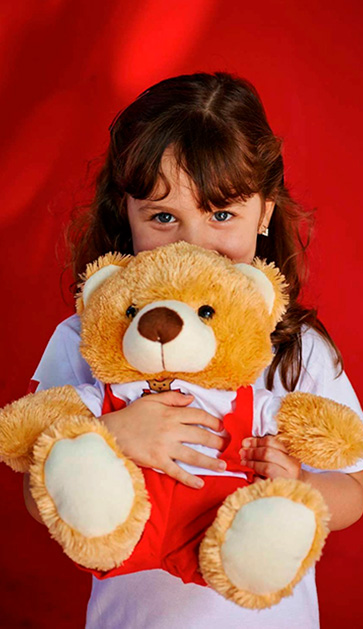
Quality is assured at all Maple Bear centres
Maple Bear centres benefit from our distinguished academic faculty of Canadian trainers, curriculum writers and quality assurance personnel.
The Maple Bear program is a living, breathing curriculum that is constantly being updated. We have a large faculty of experienced teachers and education administrators that we draw upon to develop new curriculum, new training materials and methodologies and school policies. We undertake periodic student assessment at centres to benchmark student performance.
Maple Bear provides continual professional training and support for our teachers. Trainers from the Maple Bear Faculty mentor teachers and introduce them to the latest pedagogies and instructional strategies.
Every Maple Bear centre undergoes an annual inspection that covers everything from safety equipment to classroom performance. On a regular basis and drawing on the experience of training staff in centres, we review and update our curriculum to reflect the latest developments in the field of education and changes in local regulations and requirements. All Maple Bear centres have clean, secure facilities and low student to teacher ratios.
Our goal is to establish quality centres that will provide an excellent education experience to students for generations to come.
Maple Bear students are:
CURIOUS
Passionate about knowledge and learning.

CONFIDENT
Deeply aware of their talents and potential.

INDEPENDENT
Prepared to lead their own lives, and decide their own paths and destiny.
ANALYTICAL
Able to think freely & shape their own beliefs.
FLEXIBLE
Adaptable in a world where change is the only constant.

CREATIVE
Always motivated and enthusiastic about asking “what if?”

PREPARED
In possession of the knowledge and tools necessary for an outstanding performance at college, at work and in life, in their home country or abroad.

GLOBAL
Bilingual and culturally literate for a global future.
THE MAPLE BEAR PROGRAM
All instruction in the Maple Bear Preschool follows educational principles which have made Canadian practice so successful:
Outcomes are defined: Learning is targeted to achieve very specific learning outcomes. It is clear what the children need to learn.
Canadian performance standards are applied: Canadian performance standards determine the learning outcomes. Maple Bear students are expected to achieve performance levels similar to Canadians.
Curriculum development for English-language subjects is done in Canada by Canadian experts.
Canadian style teaching strategies are implemented: Canadian teaching strategies encourage student independence, strong literacy skills, higher level thinking and problem solving.
A sophisticated set of learning resources are used: Learning resources include books, manipulative materials, visual materials, electronic media, and computer technology.
Assessment of student learning is based on Canadian standards. In all cases, Canadian programming exceeds the requirements of local elementary education authorities in each country.
Bilingual immersion methodology is used in Maple Bear schools to develop competence in languages. This means that children learn to listen, speak, read, and write in both a second language and their native language by surrounding them with conversation and instruction in both languages.
In Australia, our students are immersed in English, plus a specially developed second language curriculum that strongly emphasizes on bilingual language and literacy. Children learn in both languages right from the first day!
By the end of Senior Kindergarten, Maple Bear students will be able to
- communicate effectively in both languages by listening and speaking
- have a good understanding of alphabetical symbols
- read basic text in both languages
- use phonic strategies to approach new words
- use writing strategies appropriate for beginners
- use and respond to media
Every child deserves the best possible start in life and the support that enables them to fulfill their potential. Children develop quickly in the early years and a child’s experiences between birth andage five have a major impact on their future opportunities. Maple Bear sets high standards to ensure children’s readiness for elementary school. Maple Bear gives children the broad range ofknowledge and skills that provides the right foundation for good progress through school and life.
English Language Arts
By the end of Senior Kindergarten children will communicate effectively in English by listening and speaking, will have a good understanding of alphabetical symbols, will be able to read basic text inEnglish, will be able to use phonic strategies to approach new words, will be capable of using writing strategies appropriate for beginners, and finally, will be able to use and respond to media.
Personal and Social Development
Children will learn to share, to respect others, to listen, and to understand that people have different talents and functions in our society.
Science
Children will demonstrate curiosity about the natural world, demonstrate knowledge of characteristics of common materials and identify cycles in nature using techniques of observation.
Creative Activity
Children will understand colour, shape and use of media to express ideas. They will be able to describe responses to music, art, drama and dance.
Physical skills and well-being
Children will develop physical skills (such as balance and flexibility), an awareness of health and safety rules, an understanding of sharing, taking turns, cooperation and socially acceptablebehaviour.
Mathematics
Children will become problem solvers. They will learn about patterns in the environment, number concepts, comparisons, sets, basic formal operations (e.g. adding and subtracting), 2-D and 3-Dobjects, simple graphs, basic measurements, estimation and basic probability.
Language development and acquisition
In learning a second language children pass through several stages in a predictable order: listening, developing understanding, speaking, reading and writing. Successive stages begin whilepreceding stages are still in development. When Maple Bear children learn a second language their development proceeds through the same stages in the same sequence as in learning the firstlanguage. Research shows that learning two languages at an early age offers both linguistic and cognitive advantages.
Literacy, which includes listening, speaking, reading and writing, is one of the most important goals of the Maple Bear program.